Cricket Strike Rate & Average Calculator
In modern IPL cricket, a batsman who scores 45 runs in 40 balls inflicts more harm on his team compared to another batsman who scores 28 runs in just 12 balls. There are two numbers that explain this paradox immediately — batting average and strike rate. While traditional Test cricket favored batsmen who could stand at the crease for hours on end, the IPL has transformed performance assessment in the eyes of spectators, experts, and selectors through explosive scoring rates.
Whether you are a student researching cricket statistics, a sports hobbyist tracking your season’s numbers, or a fan formulating fantasy teams, learning the math behind the cricket strike rate and average calculator removes all guesswork from match analysis.
What Exactly Is Measured by a Cricket Strike Rate and Average Calculator?
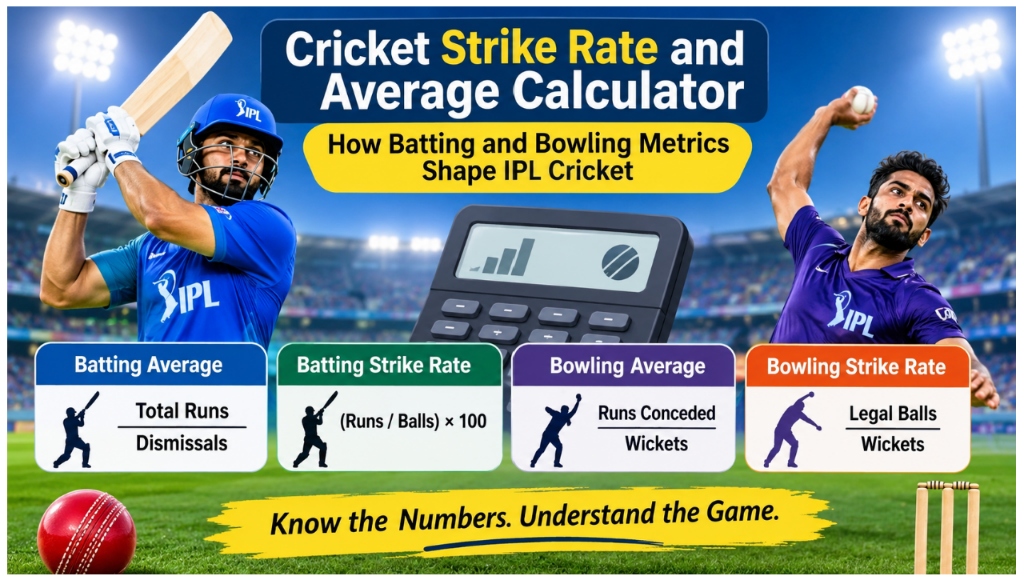
A cricket statistics calculator measures four primary performance ratios employed on international and domestic scorecards recognized by both the BCCI and ICC. Two ratios evaluate batters, while two evaluate bowlers:
- Batting Average (Consistency): Measures how many runs a batsman scores per dismissal.
- Batting Strike Rate (Speed): Measures how many runs a batsman scores per 100 legal balls faced.
- Bowling Average (Economy per Wicket): Measures how many runs a bowler concedes for each wicket taken.
- Bowling Strike Rate (Frequency): Measures how many deliveries a bowler needs to dismiss a batter.
There is an inverse relationship between these two domains: higher is better for a batsman, whereas lower is better for a bowler.
Batting Average and Batting Strike Rate Calculation Formulas
On official scorecards and tournament portals like iplt20.com, batting parameters are determined using precise mathematical formulas.
1. Batting Average Formula
A common mistake made by beginners is dividing Total Runs by Total Innings. Under official statistical criteria, "not out" innings must never be counted in the denominator (although runs accumulated in not-out innings are included in the numerator).
#### Worked Example: Suppose an IPL middle-order finisher plays 5 innings with scores of 34*, 22, 48*, 15, and 41* (where * denotes not out):
- Total Runs: 34 + 22 + 48 + 15 + 41 = 160 runs
- Innings Played: 5
- Times Dismissed: 2 (dismissed in the 2nd and 4th innings only)
- Batting Average: 160 ÷ 2 = 80.00
2. Batting Strike Rate Formula
Wide deliveries do not count toward a batter's balls faced, whereas no-balls do count as legal deliveries faced by the batter.
#### Worked Example: If an opener scores 63 runs off 35 legal balls during a powerplay and middle-overs surge:
- Calculation: (63 ÷ 35) × 100 = 1.80 × 100 = 180.00
A strike rate of 100.00 represents exactly one run for every ball faced. In IPL cricket, where par first-innings scores routinely exceed 190 to 200 runs on flat Indian pitches—such as Bengaluru's M. Chinnaswamy Stadium or Hyderabad's Rajiv Gandhi International Stadium—top-order batsmen must target a strike rate of 145.00 or higher to maintain competitive momentum.
Formulas for Bowling Average and Bowling Strike Rate
Bowlers are evaluated by their ability to contain run-scoring as well as take wickets. A cricket calculator treats bowling statistics differently from batting metrics because overs must be converted into total individual legal deliveries.
1. Bowling Average Formula
Runs conceded include runs off the bat, wides, and no-balls, but exclude fielding extras like byes and leg-byes.
2. Bowling Strike Rate Formula
Because one standard over consists of 6 legal deliveries, a bowler who delivers 3.4 overs has bowled (3 × 6) + 4 = 22 legal balls.
#### Worked Example: Consider a death-overs specialist who completes an IPL spell with figures of 4–0–28–3 (4 overs, 0 maidens, 28 runs conceded, 3 wickets):
- Total Legal Balls: 4 × 6 = 24 balls
- Bowling Average: 28 ÷ 3 = 9.33 runs per wicket
- Bowling Strike Rate: 24 ÷ 3 = 8.00 balls per wicket (one breakthrough every 8 balls)
Side-by-Side Comparison: Batting vs. Bowling Metrics
| Metric | Formula | What High vs. Low Means | Typical T20 / IPL Benchmark |
|---|---|---|---|
| Batting Average | Runs ÷ Dismissals | Higher = Better consistency | 30.00 – 40.00+ (Strong) |
| Batting Strike Rate | (Runs ÷ Balls) × 100 | Higher = Faster scoring rate | 140.00 – 160.00+ (Impactful) |
| Bowling Average | Runs Conceded ÷ Wickets | Lower = Cheaper wickets | Under 24.00 (Elite) |
| Bowling Strike Rate | Legal Balls ÷ Wickets | Lower = Faster breakthroughs | Under 18.00 (Strike bowler) |
Strike Rate versus Average in IPL Cricket
In 50-over ODIs and multi-day Test matches, preserving wickets is crucial because batting resources are scarce relative to the number of deliveries available. In a 20-over T20 match, however, a team has 10 wickets to expend across just 120 balls—meaning batting depth is abundant relative to available time.
Key tactical realignments have transformed modern IPL evaluation:
- Opportunity Cost of Dot Balls: Every ball consumed at a strike rate of 110.00 deprives an explosive teammate from facing that delivery at a strike rate of 165.00+.
- The "Not Out" Finisher Distortion: Lower-order finishers (batting at No. 6 or 7) frequently remain not out at the end of chases. Consequently, their batting averages become artificially inflated compared to top-order openers who face fresh new-ball attacks against boundary riders.
- Phase-Based Metrics: Franchise analysts and data experts on portals like BetVault Cricket dissect statistics by match phase: Powerplay (Overs 1–6), Middle Overs (Overs 7–15), and Death Overs (Overs 16–20).
For analysts evaluating match odds, fantasy picks, and online ID betting markets, weighing strike rate against real-time pitch conditions is far more predictive than tallying raw run aggregates. A batsman averaging 42.00 at a strike rate of 118.00 provides far less tactical leverage than a batter averaging 29.00 with a strike rate of 162.00.
Common Mistakes When Using Cricket Calculators
Even seasoned cricket enthusiasts make errors when calculating statistics without factoring in sample size and match context:
- Sample Size Distortion: A batter who scores 24* off 8 balls in their debut innings holds a temporary average of infinity and a strike rate of 300.00. Reliable T20 performance modeling requires a sample of at least 15 to 20 innings.
- Boundary Percentage vs. Running: Two batters can register an identical strike rate of 150.00 through completely different mechanics: one via high boundary/dot-ball variance, and another through continuous 1s and 2s. Rotating strike remains vital on expansive Indian outfields like Ahmedabad's Narendra Modi Stadium.
- Ignoring Economy Rate: A bowler's Economy Rate equals (Bowling Average ÷ Bowling Strike Rate) × 6. Inspecting average and strike rate without economy can mask whether a bowler bleeds too many runs between breakthroughs.
Frequently Asked Questions (FAQs)
How do you calculate strike rate in cricket without a calculator? Divide runs scored by balls faced and multiply by 100. For quick mental arithmetic: if a batter faces 50 balls, simply double their runs (e.g., 68 runs off 50 balls = 136.00 SR). If they face 25 balls, multiply runs by 4.
How can a batsman’s batting average be higher than their highest individual score? This occurs when a batter remains not out across multiple innings. Not-out innings add runs to the numerator without increasing the dismissals in the denominator. For example, scores of 20*, 25*, and 30 total 75 runs with only 1 dismissal, resulting in an average of 75.00 despite a high score of 30.
Do wide deliveries count toward a batter’s strike rate? No. Wides are recorded as extras against the bowling side and do not count as legal balls faced by the batsman. No-balls, however, do count as legal balls faced.
What is considered a good bowling strike rate in the IPL? Any bowler with a career IPL strike rate below 18.00 (taking a wicket every 3 overs) ranks among the tournament's top wicket-takers. Elite death-overs specialists and wrist spinners typically average between 14.00 and 17.00 balls per wicket.
How do batting average and strike rate combine into composite indexes? Analysts often employ the Basra Index (Batting Average + Strike Rate) or the Impact Index ((Average × Strike Rate) ÷ 100) to balance scoring volume with speed. While not official ICC metrics, both are widely utilized in T20 player scouting and fantasy algorithms.
Can a bowler have an excellent bowling average but a poor strike rate? Yes. Defensive finger spinners who operate in the middle overs frequently maintain economy rates below 6.00 runs per over while taking few wickets. For instance, spell figures of 4–0–18–1 yield an impressive bowling average of 18.00, but a modest strike rate of 24.00 balls per wicket.
The Takeaway: Precision Behind Player Valuation
Cricket strike rate and average calculators convert scorecard digits into actionable insights about true player impact. By factoring in match conditions, boundary dimensions, and phase-specific requirements, these fundamental formulas provide the benchmark for modern IPL and T20 analysis.
Ready to Start Betting?
Get your Bet Vault cricket betting ID set up in minutes — just message us on WhatsApp.
Get My Betting ID Now