Cricket field is not merely a patch of dirt but is the only element that determines the course of the match. Even before the bowling begins, the captains get down to their knees and examine the field, feel the dirt with their thumbs, look at the grass cover and the crevices. Even before there is any sort of strategy being executed between bat and ball, the 22 yards decide whether the side requires another fast bowler or whether two wrist spinners can be fielded.
For those interested in analysis and strategy formulation through an online platform, the knowledge about surface dynamics becomes essential. Be it about examining the balance of sides in the ongoing match or signing up for BetVault Cricket using a Cricket id online bet, knowing the behavior of various types of pitches becomes necessary.
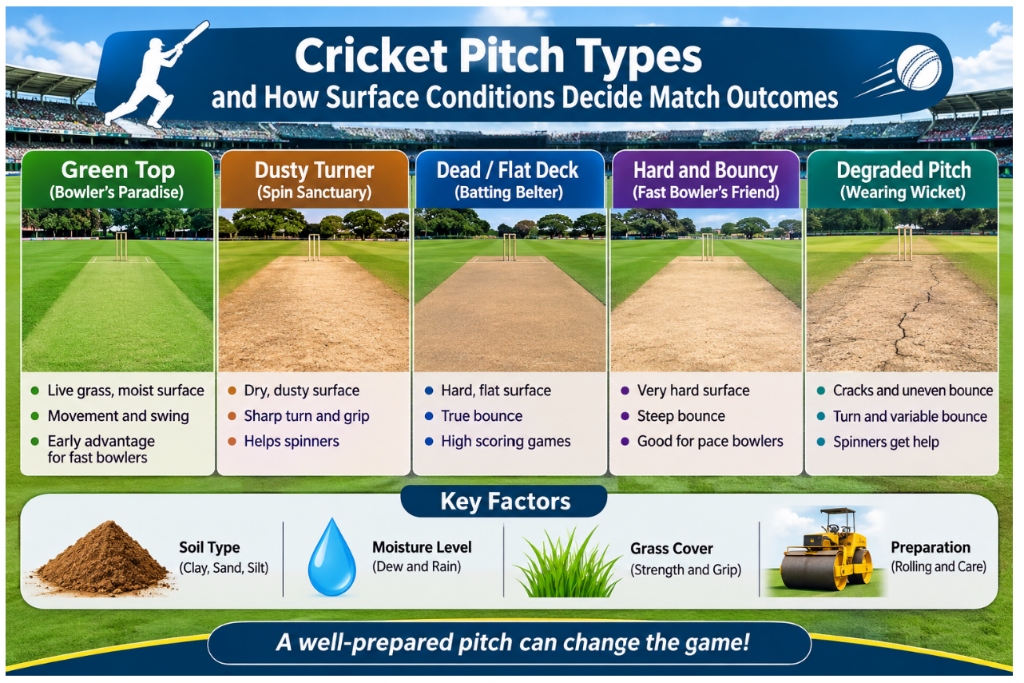
The Science of the Strip: Soil, Moisture, and Preparation
Each cricket strip is made up of soil, which is a mixture of clay, silt, and sand, placed above a drainage base. Under the rules of the ICC and national cricket boards such as the BCCI, there are three primary elements that curators control in order to give the strip its characteristic playing properties:
- Clay Content: Soil with high clay content (greater than 50%) binds together firmly to form a hard crust capable of carrying a true and reliable bounce. Low clay content soils crack easily under fast bowling impacts, producing unpredictable bounce and early loose dust.
- Moisture Content: Moisture present deep within the pitch foundation gives initial movement off the seam. Moisture on the surface evaporates rapidly under sunlight, causing clay contraction that subsequently opens up cracks.
- Grass Cover: Live green grass acts as a binder to provide surface tensile strength and retain moisture for lateral seam deviation. Dead, dried, or closely clipped grass acts merely as a dry skin with minimal seam assistance.
The Five Principal Cricket Pitches
Whereas microclimates and weather variations cause subtle nuances, world cricket pitches are categorized into five principal types:
1. Green Top (Bowler’s Paradise)
- Physical Characteristics: Visible layer of live green grass; moist early in the morning session.
- Gameplay: Sharp sideways deviation off the seam, exaggerated bounce, and lateral swing—especially under overcast skies.
- Match Effect: Early on, fast bowlers dominate completely. Batters must play close to their body, respect the moving ball, and leave deliveries outside off-stump. Toss-winning captains almost always choose to bowl first.
- Famous Grounds: Headingley (Leeds), Basin Reserve (Wellington), SuperSport Park (Centurion), and Eden Gardens (Kolkata) under morning cloud cover.
2. The Dusty Turner (Spin Sanctuary)
- Visual Description: Dry, pale, bare surface with low topsoil binding and loose dust patches around bowler landing areas.
- Behavior: Slower pace and lower bounce for seamers. From Day 1 or 2 onward, the ball bites into the dusty crust, generating sharp turn and variable bounce. As bowler footmarks widen, puffing dust makes bounce even more unpredictable.
- Impact on the Match: Spinners take the new ball within the powerplay in white-ball matches, or operate from Day 2 in Tests. Batting first is mandatory; surviving a fourth-innings chase is hazardous.
- Classic Examples: MA Chidambaram Stadium (Chepauk, Chennai), Green Park (Kanpur), and Galle International Stadium (Sri Lanka).
3. Dead / Flat Deck (Batting Belter)
- Appearance: Hard, compressed, heavily rolled pitch with minimal grass and no surface moisture.
- Performance: Consistent bounce with uniform pace off the wicket, offering minimal lateral seam or spin movement. The ball comes onto the bat at an even, predictable height.
- Effect on Matches: Dominated by high scores and run feasts. Bowlers must rely on reverse swing, disguised cutters, and pinpoint yorkers to stay competitive. In Test matches, flat decks frequently produce draws.
- Famous Grounds: Rawalpindi Cricket Stadium, National Stadium (Karachi), and traditional flat tracks at Arun Jaitley Stadium (Delhi).
4. Hard and Bouncy Pitches
- Visual Description: Firm, light-toned, highly compacted clay surface with a thin, evenly trimmed lawn layer.
- Performance: Highly elastic surface that efficiently translates bowler kinetic energy into steep vertical carry. Hit-the-deck fast bowlers exploit this bounce to target batter ribcages. Batters proficient in back-foot cuts and pulls excel here.
- Effect on Match: Through-the-line strokeplay is rewarded with true bounce. High bowling pace is lethal. Spinners succeed primarily when using over-spin and flight rather than side-spin.
- Notable Locations: WACA Ground and Perth Stadium (Perth), The Gabba (Brisbane).
5. Degraded / Wearing Wicket
- Visual Characteristic: Starts firm on Day 1 but progressively deteriorates under solar radiation and spike marks, showing wide network cracks by Day 4 and 5.
- Behavior: Unpredictable vertical trajectory, combining ankle-high shooters with sudden shoulder-high lift. Balls hitting fissure cracks deviate dramatically ("fishtailing").
- Impact on Match: Winning the toss and capitalizing on the first two batting days dictates the match. Fourth-innings targets exceeding 180 runs become formidable defensive totals.
- Classic Grounds: Subcontinental classic Test venues such as Wankhede Stadium (Mumbai), Narendra Modi Stadium (Ahmedabad), and the SCG during late Test match days.
Pitch Comparison Matrix
| Pitch Type | Primary Weapon | Ideal Tactical Approach at Toss | Average Par Score (First-Innings ODI) | Decisive Characteristic |
|---|---|---|---|---|
| Green Top | Seam & Swing Bowlers | Bowl First | 210–240 | Sharp seam deviation; early collapse risk |
| Dusty Turner | Finger & Wrist Spinners | Bat First | 220–250 | Grip, variable bounce, footmark erosion |
| Flat Deck | Power-hitters | Bat First | 320–360+ | Even bounce, true carry, minimal lateral movement |
| Hard & Bouncy | Hit-the-Deck Pacers | Bat / Bowl Balanced | 280–310 | Steep bounce, high reward for horizontal-bat shots |
| Deteriorating | Spinners & Reverse Swing | Bat First | 240–270 | Widening cracks, unpredictable vertical bounce |
Venue Dynamics of Indian Grounds: Red Soil vs. Black Soil
In Indian domestic and international fixtures, surface behaviour is fundamentally driven by soil chemistry:
- Red Soil (e.g., Wankhede Stadium, Mumbai): High clay-sand proportion with lower water retention that dries rapidly. It breaks down into coarse particles, maintaining true carry, extra bounce, and faster turn. Pace bowlers enjoy good carry to the keeper, while batters can hit through the line.
- Black Soil (e.g., Chepauk, Chennai; Motera black-soil pitches): Rich in clay minerals with elastic properties and high moisture retention. As a result, black-soil pitches provide lower bounce, absorb ball pace, and play significantly slower. Batters must accumulate patiently with wristy placement, while seamers rely on off-cutters and change-of-pace.
When setting up analytical strategies and evaluating live odds through Online Betting OId, correlating squad selection with stadium soil profile is crucial.
Key Match Factors Influenced by Pitch Conditions
The Distortion Factor of Night Dew
For day-night ODIs and T20 fixtures across India from October through February, heavy evening dew drastically alters second-innings behavior. A pitch that offered grip and turn in the dry afternoon can become a slick batting surface under lights. The wet ball slides onto the bat, preventing spinners from gripping the seam and neutralizing pitch erosion. Consequently, teams overwhelmingly elect to chase to negate the dew disadvantage.
Wear, Tear, and Lethal Reverse Swing
On abrasive subcontinental pitches, rough surfaces and dry outfields rapidly strip the protective shine from one side of the leather ball. While conventional swing diminishes after the initial overs, reverse swing becomes the most dangerous weapon in the middle and death overs when delivered by skilled fast bowlers.
Frequently Asked Questions (FAQs)
What is the effect of pitch moisture on swing and seam bowling? Moisture primarily benefits seam bowlers because the raised seam digs into the damp surface, generating lateral deviation and unpredictable skid off the turf. Swing, on the other hand, is governed predominantly by atmospheric conditions and ball surface maintenance.
Why do spinning deliveries grip earlier on Indian tracks than Australian tracks? Indian pitches feature clay-silt soils that crumble into fine dust under subtropical heat, creating an abrasive surface the ball grips instantly. Australian pitches utilize high-tensile clay (such as Bulli soil) that bakes into a rock-hard crust, providing bounce and speed rather than surface dust.
What is a drop-in pitch and what are its characteristics? A drop-in pitch is prepared in concrete or steel trays off-site and transported into multi-purpose stadiums prior to the cricket season. Common in venues like the Melbourne Cricket Ground (MCG), drop-in pitches provide consistent bounce and uniform compaction, though they generally deteriorate more slowly than traditional pitches.
Is using the heavy roller advantageous for batsmen or bowlers? The heavy roller flattens surface irregularities, compresses the crust, and temporarily seals micro-cracks, delivering true bounce and easy run-scoring for the initial session. However, once that compressed crust dries out under the sun, it tends to crack more aggressively.
How does atmospheric humidity influence a dry pitch? High ambient humidity prevents the pitch surface from drying rapidly, reducing crack formation. It also keeps the leather ball conditioned, occasionally delaying the onset of reverse swing.
The Takeaway: Science Behind the 22 Yards
Every cricket match outcome is a direct reflection of how twenty-two players adapt to the twenty-two yards beneath them. Teams that misread soil composition, pace/spin balance, or deterioration rates find themselves defending inadequate totals. Analyzing clay chemistry, moisture levels, and surface wear provides a complete lens for predicting momentum swings and match results.
Ready to Start Betting?
Get your Bet Vault cricket betting ID set up in minutes — just message us on WhatsApp.
Get My Betting ID Now